
Glossary: Look up unfamiliar words.
| CMS | CMS Glossary |
| Dimuon | Dimuon
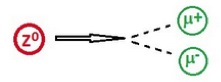
A dimuon or "dimuon pair" is a muon-antimuon pair that results from a particle decay. For example, the Z boson can decay into dimuons. |
| Muon | Muon
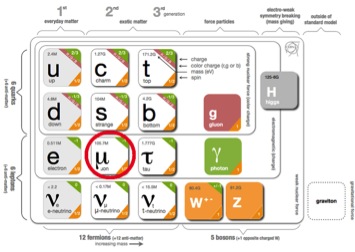
The muon (from the Greek letter μ) is an elementary particle similar to but much more massive than the electron.
The muon has electric charge -1 and a spin 1/2; an antimuon is the same but with charge +1.
The muon is classified, with the electron, the tau, and the neutrinos, as a lepton. Leptons are fundamental particles
that do not interact via the strong force. |
| abstract | Abstract: An abstract is a shortened version of the paper and should contain all information necessary for the reader to determine:
|
| metadata | Metadata (meta data, or sometimes metainformation) is "data about other data". The e-Lab stores metadata for the Cosmic Ray data files, plots and posters. Searching metadata is a powerful way to find the data you want. Read more about metadata on Wikipedia. |
| milestone | The color of the dot indicates where on the site you will be working for that milestone (for example, blue dots correspond to the Data section). |
| milestone seminar | |
| milestone seminar text | Take this opportunity to discuss your progress and understanding with your teacher. |
| milestone text | |
 Scientists have software to plan and track their projects. Our online version includes these milestones with references and a logbook that allow you to plan and track your work.
 Scientific collaborations hold regular meetings to track progress on their projects. Leaders also schedule impromptu meetings for smaller groups focused on an aspect of the larger project. Teachers may hold milestone seminars to discuss your progress and understanding.
 Scientists have software to plan and track their projects. Our online version includes these milestones with references and a logbook that allow you to plan and track your work.